Carnegie Moscow Center

There are different prisms through which one could analyze the problems of Russia: that of the upcoming elections; that of center-periphery relations (Chechnya); that of Putin's leadership, and so on. But the one angle in particular that would yield the most insight into the challenges currently facing Russia is the relationship between power and big business, highlighted by the Yukos scandal.
Listen to a panel discussion with Thomas L. Friedman, Adel Abdellatif, and Gilles Kepel.
A discussion meeting with Jayhun Mollazade, President of the U.S. – Azerbaijani Council, Carnegie Visiting Scholar Edward Chow and Senior Associate Martha Brill Olcott.
A discussion meeting with Igor Malashenko, President of Overseas Media Productions, Inc.
A discussion with Chinara Jakypova, Project Director of the Bishkek office of the Institute for War and Peace Reporting, on political, economic, and social tendencies in Kyrgyzstan.
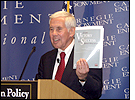
Event based on the FP-Carnegie special report, "From Victory to Success." Event included remarks by Sen. Richard Lugar. Click for audio and video of his remarks.

Veron Hung analyzed the political, social, and economic circumstances surrounding the recent crisis and discuss how it has changed the political dynamics in Hong Kong. Minxin Pei covered how this crisis has influenced elite politics in China and examined its ramifications.
A seminar on implementation of nuclear reductions now that the Moscow Treaty has entered into force, and the potential for cooperation on some of the proliferation “tough cases,” especially Iran and North Korea with an eminent group of Russian military and security experts.
Launch of an important new book, Tactical Nuclear Weapons: Emerging Threats in an Evolving Security Environment, featuring presentations by the book’s editor, Alistair Millar, and several of its contributing authors, including Joshua Handler, Timothy Hoyt, and Robert Nelson.
Observers often think that policymakers make decisions as a result of carefully reasoned and vetted processes that take into account potential strategic and long-term implications. In reality, decisions by both U.S. and Chinese officials concerning the bilateral relationship have been made on the basis of very personal and short-term political reasons.